Stay informed about safety tips, industry news, and emergency preparedness updates by subscribing to our newsletter.
From Devastation to Restoration
A fire can change everything in a matter of minutes. Even after the flames are extinguished and the fire department leaves, the damage is often far from over. Smoke, soot, water, moisture, strong odors, and damaged building materials can remain throughout the property.
For homeowners and business owners, looking at the damage can be overwhelming. You may be wondering: What happens now? Can my property be saved? Who cleans up all this water and smoke damage? Where do I even begin?
That is where professional fire restoration services become essential.
At Phoenix Fire & Water Restoration, our job begins when the emergency response ends. We help property owners move from devastation toward recovery by cleaning, drying, protecting, and restoring fire-damaged properties.
The Fire Is Out — But the Damage Isn’t Over
One of the biggest misconceptions about fire damage is that once the flames are extinguished, the emergency is over.
Unfortunately, that is rarely the case.
Firefighters may need to use significant amounts of water to control a fire. Walls and ceilings may be opened to reach hidden flames. Windows and doors may be damaged. Smoke and soot can travel into rooms that were never directly touched by the fire.
The result can be a combination of fire, smoke, soot, water, moisture, and structural damage throughout the property.
The sooner the restoration process begins, the sooner these problems can be identified and addressed.
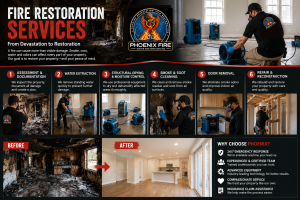
Step 1: Assessing and Documenting the Damage
Every restoration project begins with understanding exactly what happened to the property.
Our team evaluates the affected areas and documents visible damage. Photographs and detailed records help establish the condition of the property and identify materials and areas requiring attention.
When necessary, specialized equipment can also be used to identify moisture that may not be visible to the naked eye.
Proper documentation is particularly important when an insurance claim is involved because it helps create a clear record of the damage and the restoration work required.
Step 2: Water Extraction After Firefighting
Water damage is one of the most common secondary problems following a structure fire.
The water that helped save your property can remain trapped in flooring, walls, ceilings, insulation, carpeting, and other building materials.
Standing water should be removed as quickly as possible.
Professional extraction equipment can be used to remove accumulated water before the structural drying process begins.
Removing the visible water, however, is only the beginning.
Step 3: Structural Drying and Moisture Control
A building may appear dry while significant moisture remains hidden inside its structure.
That moisture can potentially contribute to additional property damage and create conditions favorable to microbial growth.
Professional restoration technicians use equipment such as commercial air movers, dehumidifiers, moisture meters, thermal imaging equipment, and air filtration systems to help locate moisture and properly dry affected areas.
The drying process continues until appropriate moisture conditions are achieved.
Step 4: Smoke and Soot Cleaning
Smoke does not stay in the room where the fire started.
It can travel through hallways, HVAC systems, wall cavities, and adjoining rooms. Fine soot particles can settle on walls, ceilings, furniture, flooring, appliances, and personal belongings.
Different surfaces require different cleaning techniques.
Professional smoke and soot cleaning helps remove contamination while determining which materials can potentially be cleaned and restored and which may need to be removed.
Step 5: Addressing Smoke Odors
Even after visible soot has been cleaned, the smell of smoke may remain.
That happens because smoke particles can penetrate porous materials throughout the property.
Simply spraying an air freshener does not solve the underlying problem.
Professional odor-control procedures may include specialized cleaning, air filtration, HEPA air scrubbers, hydroxyl treatment, and other appropriate restoration methods depending on conditions at the property.
The objective is not simply to cover up the smell. It is to address its source.
What Happens to Clothing and Personal Belongings?
After a fire, homeowners frequently discover that clothing, fabrics, and personal belongings smell strongly of smoke or have been contaminated by soot.
Do not assume everything has to be thrown away.
Phoenix Fire & Water Restoration provides dry-cleaning services for qualifying smoke-affected clothing and textiles. Items can be evaluated, carefully handled, cleaned when appropriate, and prepared for return.
Our team can also assist with the pack-out process, helping organize and remove belongings from affected areas when necessary so restoration work can proceed.
Moving Toward Reconstruction
Once water has been extracted, the structure has been properly dried, and damaged or contaminated materials have been addressed, the property can move toward the rebuilding phase.
Depending on the severity of the fire, reconstruction may involve replacing drywall, ceilings, flooring, insulation, cabinetry, doors, trim, painting, and other structural or cosmetic components.
If a property owner does not already have a qualified contractor, Phoenix Fire & Water Restoration can help make an introduction to a trusted contractor who can discuss the reconstruction process, credentials, previous projects, and the work required to rebuild the property.
Fire Restoration Is About More Than Cleaning
Restoration is not simply about removing debris.
It is about helping take a damaged property from the chaotic condition left after a fire and moving it toward being clean, dry, safe, and ready for the next phase of recovery.
For families, it also means having someone who understands that behind every damaged wall, piece of furniture, or box of belongings is a home and a life that has suddenly been disrupted.
For business owners, every day the property remains unusable can affect employees, customers, operations, and revenue.
That is why an organized restoration process matters.
Why Acting Quickly Matters
Fire damage can continue affecting a property after the flames are gone. Water can migrate into surrounding materials, soot can settle on additional surfaces, odors can penetrate porous materials, and prolonged moisture can create additional complications.
Early professional assessment allows the restoration team to determine what needs immediate attention and develop an appropriate plan for the property.
The goal is simple: protect what can be saved, properly address what has been damaged, and help move the property toward recovery as efficiently as possible.
From Devastation to Restoration
Seeing your home or business immediately after a fire can make recovery seem impossible.
But what you see immediately after the fire does not have to be the final chapter of your property.
At Phoenix Fire & Water Restoration, we are ready to assist through the critical stages of fire and water damage recovery—from initial assessment and documentation to water extraction, structural drying, smoke and soot cleaning, odor treatment, pack-out services, and preparation for reconstruction.
The fire may be over. Your recovery is just beginning.
Need Help After a Fire?
If your home or business has suffered fire, smoke, soot, or water damage, contact Phoenix Fire & Water Restoration to discuss the next steps.
Turning Devastation Into Restoration.
Phoenix Fire Water Restoration is ready to assist you through every phase of your property recovery.
718-200-0592
118-21 Queens Blvd,Suite 505 Forest Hills, NY,11375
operations@phoenixfirewater.co claims@phoenixfirewater.co
Copyright © 2026 Phoenix Fire & Water All rights reserved Designed and Maintained By : WQC Designs Studio